
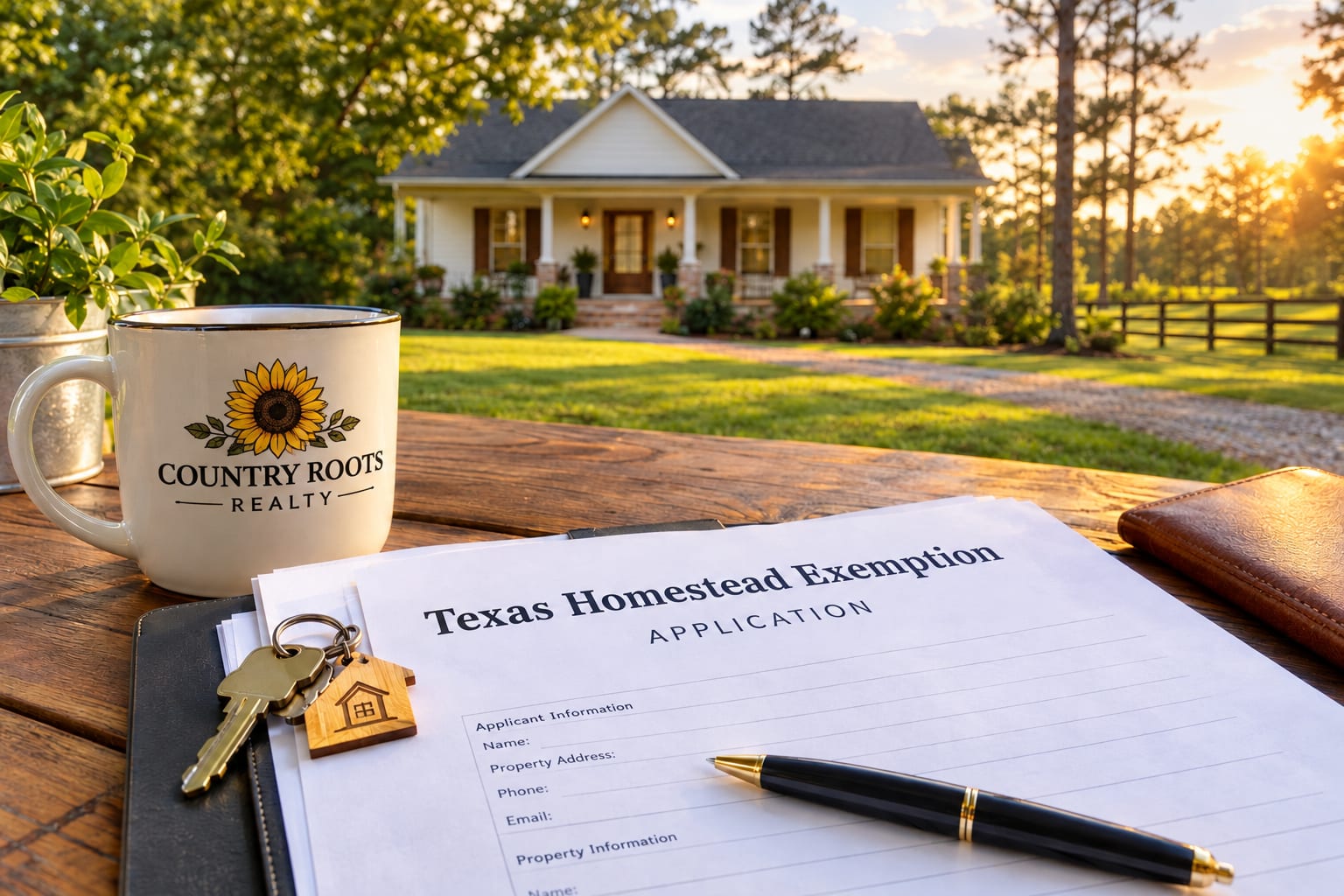
Just Bought a Home in East Texas? Great, but Don't Forget to File for Your Property Tax Exemptions!
Congratulations on your new home! You made it through the house hunting, negotiations, inspections, paperwork, and closing. The keys are in your hand, the moving boxes are piling up, and you are finally getting settled into your new place in the East Texas Pineywoods.
But before you get too comfortable, there is one important post-closing task you do not want to overlook: applying for the property tax exemptions you may qualify for.
This is one of those things that can easily get lost in the excitement of buying a home. Many buyers may think their real estate agent, mortgage lender, title company, or closing attorney automatically takes care of this after closing, but that is not true. While those professionals help guide you through the transaction, applying for your property tax exemptions is a separate responsibility for the new homeowner.
At Country Roots Realty, I want my buyers to feel confident not only on closing day, but also as they settle into homeownership. Understanding your property tax exemption options is an important part of protecting your investment and making the most of your new home.
What Is a Texas Homestead Exemption?
A Texas residence homestead exemption can reduce the taxable value of a qualifying primary residence, potentially lowering the property taxes you owe.
For eligible homeowners, this can make a meaningful difference in the annual cost of owning a home.
Texas provides a mandatory school district residence homestead exemption of $140,000 under current law. Additional exemptions may be available depending on your circumstances and the taxing units serving your property.
However, there is an important distinction: buying a home does not automatically mean your homestead exemption has been applied.
In most cases, you must submit an application to the appraisal district in the county where the property is located. The appraisal district determines whether you qualify and whether the exemption will be approved.
You can review the official state information and application through the Texas Comptroller's website:
https://comptroller.texas.gov/taxes/property-tax/exemptions/
When Should You Apply for your Tax Exemptions After Closing?
The general deadline for filing a residence homestead exemption application is April 30 of the tax year for which you are requesting the exemption. However, Texas law includes specific provisions for homeowners who purchase qualifying property after January 1.
Depending on the circumstances, a buyer who acquires and qualifies for a homestead after January 1 may be eligible for an exemption for the applicable portion of that same tax year, provided the previous owner did not already receive the same exemption for that year.
That means you should not automatically assume you must wait until the following January to apply.
My recommendation? Once your purchase has closed and you have established the property as your principal residence, contact the appropriate county appraisal district or review its official application instructions. Ask which application procedure and documentation apply to your particular situation.
You may need to already have your new address updated on your drivers licenses, have the recorded copies back of the new warranty deed, and have all required applications and documentation that appraisal district office requires for applying.
Step-by-Step: How to Apply for Your Homestead Exemption
The process is generally straightforward, but you will want to make sure you submit the correct information.
Step 1: Confirm That Your New Home Qualifies
A residence homestead generally must be a property in which you have an ownership interest and that you occupy as your principal residence.
A second home, vacation property, or investment property that you do not use as your principal residence generally will not qualify for the ordinary residence homestead exemption.
If you purchased a home with acreage, ask the appraisal district how the residence homestead exemption applies to your particular property and whether additional land or other property classifications require separate consideration.
Step 2: Find the Correct County Appraisal District
Your application goes to the appraisal district responsible for the county where your property is located, not to the Texas Comptroller.
For Country Roots Realty clients, this may mean contacting one of the appraisal districts serving our East Texas area:
Panola County: For properties in and around Carthage, Beckville, Gary, and surrounding communities.
Shelby County: For properties in and around Center, Tenaha, Timpson, Joaquin, and surrounding communities.
Rusk County: For properties in and around Henderson, Mount Enterprise, and surrounding communities.
Harrison County: For properties in and around Marshall and surrounding communities.
Make sure you use the appraisal district for the actual county in which your property sits, especially if you live near a county line.
Step 3: Complete the Application and Gather Your Documents
Texas uses the Residence Homestead Exemption Application, Form 50-114. Depending on your circumstances, additional affidavits or supporting documentation may be required.
You can find the official form here:
https://comptroller.texas.gov/forms/50-114.pdf
Read the instructions carefully. The application may require information verifying your ownership, identity, residence, and eligibility. Make sure the information is accurate and provide any documentation the appraisal district requests.
Step 4: Ask About Additional Exemptions
The general homestead exemption is not the only exemption that may be available to qualifying property owners.
Depending on your circumstances, you may want to ask about:
Age 65 or older: Additional residence homestead tax exemptions may be available to eligible homeowners.
Disability: Qualifying homeowners may be eligible for additional exemptions.
Disabled veterans: Texas law provides property tax benefits for qualifying disabled veterans, with the amount and eligibility depending on the applicable requirements.
Surviving spouses: Certain surviving spouses may qualify for continued or additional benefits under specific conditions.
Other qualifying circumstances: Depending on the property and owner, other exemptions or special valuation programs may be relevant.
Some benefits require additional documentation or separate applications. Do not assume that filing one form automatically applies every exemption for which you might qualify.
Step 5: Confirm That Your Application Was Received and Approved
Submitting the application is an important first step, but do not stop there.
Keep a copy of your application and any confirmation you receive. If you do not hear back, contact the appraisal district to confirm the status.
Once your exemption is approved, review your appraisal district records and subsequent tax statements to make sure the exemption is reflected appropriately.
If you believe you qualified for a prior tax year but did not receive the exemption, ask the appraisal district whether a late application or other corrective action is available. Texas law allows certain late homestead applications, subject to applicable deadlines and exceptions.
What If You Bought Land or a Farm Instead of a Traditional Home?
This is especially important here in East Texas, where so many buyers are looking for acreage, pasture, timberland, hunting property, or a place to build their dream home.
A residence homestead exemption and an agricultural or timberland special appraisal are not the same thing.
If you purchased rural property, you may have questions about agricultural or timber productivity valuation, commonly referred to as an agricultural or timber exemption. These programs have their own qualification rules, application requirements, and deadlines.
For example, owning acreage or keeping a few animals does not automatically qualify land for agricultural productivity valuation. The appraisal district evaluates whether the property meets the applicable requirements for the relevant use and history.
If your purchase includes a house and acreage, ask the appraisal district which portions of the property may qualify for a residence homestead exemption and whether any land qualifies for a separate special appraisal.
This is particularly important when buying rural property in Panola, Shelby, Rusk, or Harrison County. Do not assume that a prior owner's agricultural or timber valuation will automatically continue under your ownership without any additional steps.
Don't Assume the Seller's Previous Tax Exemption Automatically Transfers to You
When you purchase an existing home, the seller may already have had a homestead exemption or another qualifying tax benefit.
That does not mean you should assume the exemption automatically transfers to you for future tax years.
The prior owner's eligibility and exemption status do not establish your own eligibility. Your ownership, residence, qualifying circumstances, and applicable tax-year rules matter.
Ask the appraisal district how the prior exemption affects your application and whether you can qualify for an exemption for the current tax year.
It is also wise to understand that a property's previous tax bill may not accurately reflect the taxes you will owe going forward. Ownership changes, appraisal values, exemptions, and other factors can affect the amount.
When budgeting for a new home, make sure you understand the estimated taxes that apply to your circumstances rather than relying solely on the seller's past tax bill.
A Simple Post-Closing Checklist for East Texas Homebuyers
Once you have closed on your new property, add these tasks to your homeownership checklist:
Confirm that your deed and ownership information are being processed appropriately.
Contact the correct county appraisal district.
Determine whether your new home qualifies for a residence homestead exemption.
Ask whether you qualify for age, disability, veteran, or other applicable exemptions.
If you purchased acreage, ask about agricultural or timber productivity valuation requirements.
Complete the required application and provide supporting documentation.
Save your confirmation and follow up on the application status.
Review your appraisal district records and future property tax statements.
These steps may not be as exciting as choosing paint colors or planning the landscaping, but they are an important part of being an informed homeowner.
Important note: This article provides general educational information about Texas property tax exemptions and is not legal or tax advice. Eligibility, documentation, and deadlines vary by exemption and individual circumstances. Contact your county appraisal district for guidance specific to your property.

Hi there! My name is Melissa Summers and the am the Broker & Owner of Country Roots Realty. I would be happy to help you with all of your real estate buying and selling here in East Texas.